The short version: The New Stanford Prison Experiment launched on Netflix on October 21, 2026, with six episodes. Producers Jane Lipsitz and Dan Cutforth put 30 participants in a decommissioned section of the Adult Detention Center in Cherokee County, Georgia: 8 guards and 22 prisoners. Six people dropped out. Variety, which interviewed the producers before release, describes a dark turn on day six and names one participant, “Scary” Larry Foy. It does not name the six who left, and this guide will not guess.
The series is out, so episode-by-episode detail is easy to stumble into. Everything below is limited to what Variety and Netflix Tudum have published. Where those pieces stop, so do we.
What it is, and when it came out
Tudum’s release note, dated October 21, says the series launched that day on Netflix with six episodes. Variety’s feature, dated October 18, said it was debuting October 21.
Lipsitz and Cutforth executive produce through their company Alfred Street Industries. Their other shows include Top Chef and Project Runway. The question they say the series is built around is “Does power corrupt?”
Netflix is the home of the series in the US and the UK.
The setup, as the producers describe it
The original Stanford Prison Experiment, in August 1971, was a study by Stanford psychologist Philip Zimbardo. Variety’s account: 24 male college students, a mock prison in the psychology department, random assignment as guard or prisoner, and the study stopped on the sixth day. It is now widely treated as an ethical failure, including because Zimbardo also acted as the prison superintendent. Tudum calls the original a flawed study of all-male college students that “spiraled out of control in just six days.”
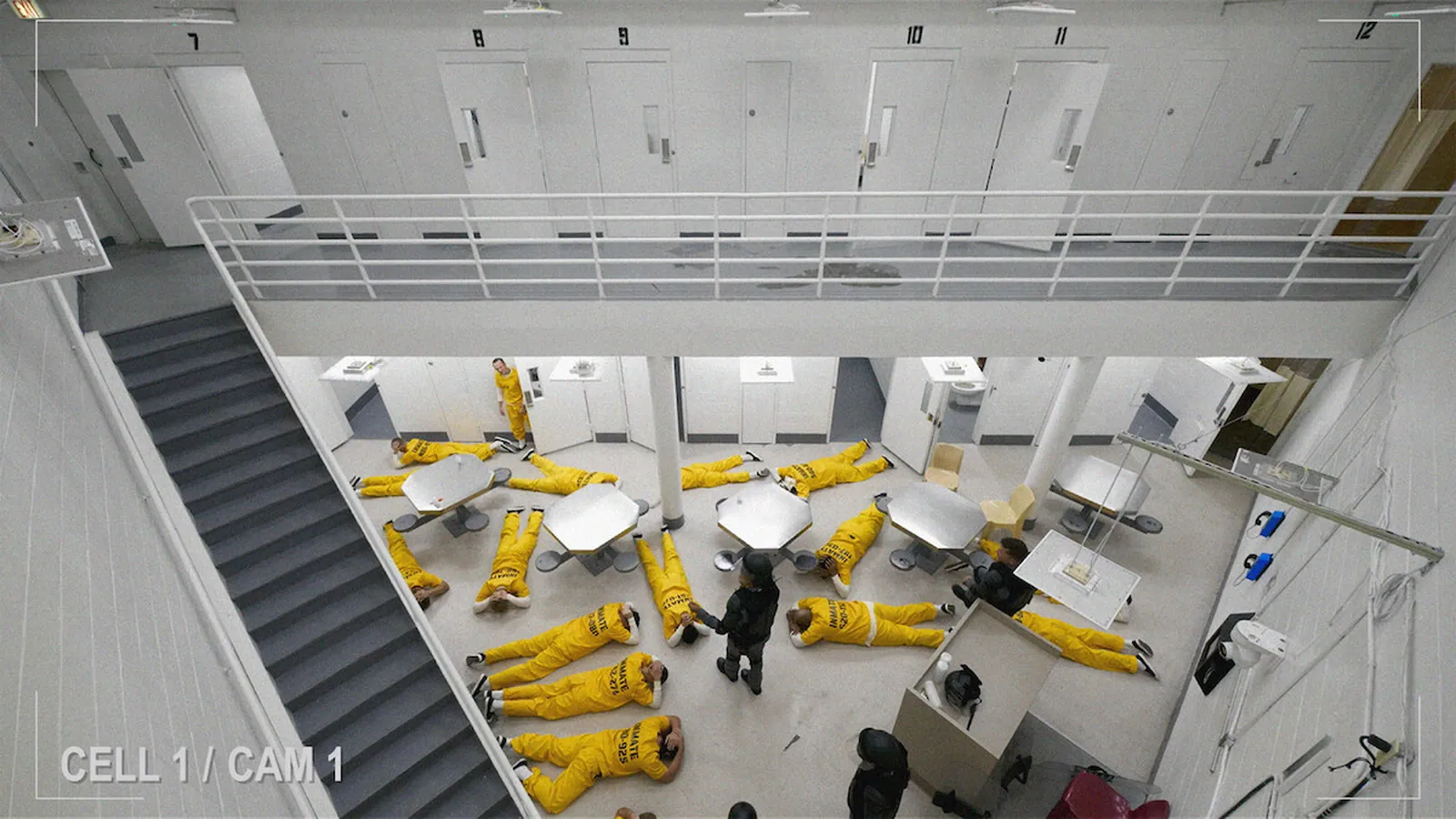
The Netflix series is not that study restaged on a campus. Variety says 30 participants, from different backgrounds and including three women, were taken to a decommissioned section of a real working prison, the Adult Detention Center in Cherokee County, Georgia. Eight were assigned as guards, split into a day shift and a night shift. Twenty-two were prisoners. The plan was two weeks. Real prisoners were on the other side of the walls. Lipsitz told Variety the yelling those prisoners directed at the participants “was real,” and Cutforth said it contributed to some people dropping out.
There was no crew in the pod. Variety and Tudum both say the pod was shot on robocams, so the participants would not be playing to a camera operator. Tudum adds that interviews were done so participants could not see the interviewer, and that people still ended up talking to the cameras.
Who is in it
A full cast list is not in either piece. The participants Variety and Tudum actually name are below. Everyone else is described only as part of the group of 30.
Producers
- Jane Lipsitz and Dan Cutforth, Alfred Street Industries
The participant Variety names
- “Scary” Larry Foy. Variety says that, by his own estimation, he had spent more than 300 days in jail, and that on the show he tells a cellmate he had tried to kill his brother. Lipsitz told Variety there were participants who had been to jail, that background checks and psychological testing were extensive, and that Foy “had done a lot of recovery work and works as an advocate now for reform.” She said it mattered to the producers not to “put people into the population who posed a threat.” Variety does not say that he quit, and it does not say how his story ends.
On the real-jail side of the production
- Major Boughner, who Variety says commanded both the working jail and the experimental pod. Variety also says the production paid for off-duty guards to be on hand. It does not give Boughner a first name.
The three experts watching the experiment
Tudum and Variety agree on the panel. They did not always agree with each other, Lipsitz told Tudum.
| Expert | How the producers describe them |
|---|---|
| Alison Wood Brooks | A behavioral scientist at Harvard Business School. Tudum also calls her a behavioral psychologist. Lipsitz says she helped keep the experiment inside the ethical limits the production had set. |
| Trymaine Lee | A Pulitzer Prize-winning journalist. Tudum says he pushed the team on the larger questions the experiment was raising. |
| Michael Cantrell | A former federal corrections officer. Tudum says he has close to 30 years in that work, and that he was there to say what felt real and what did not. |
Participants were paid. Lipsitz and Cutforth would not tell Variety how much. Lipsitz said they did not want the money to be the reason people stayed.
Who quit
Six people dropped out, Cutforth and Lipsitz told Variety, after it became too intense. Not all of those departures are in the finished series. Variety does not publish the six names. Tudum does not either. “Who quit” is, for now, a number rather than a list.
Cutforth tied some of the early exits to the moment real prisoners on the other side of the wall started shouting. That is his account of a contributing factor, not a list of reasons for each person.
What they have said about day six
Variety’s feature says it is not giving too much away, then describes this much: on day six, the same day the 1971 study was stopped, one team of guards puts down a possible uprising with a punishment the other guard shift sees as extreme. After that, the production uses several “interventions,” including asserting the hierarchy and what Variety calls a staggering role reversal. Lipsitz told Variety there were moments when the producers thought this version would also end on day six.
She also said it was “much more emotionally intense than physically intense,” that there were “moments of real concern,” and that “the actual prison guards never had to go in and intercede.”
That is the whole of the plot either outlet has put in print. We are not filling in what the six episodes show past it.
Lipsitz told Variety the series convinced her that “Does power corrupt?” was not the right question, and that viewers will land in different places. Cutforth said it will cause arguments. Tudum quotes her saying, “What we discovered during this process was something we never saw coming,” without saying what that was.
The safeguards they say were in place
Both outlets list guardrails the 1971 study did not have. Taken together:
- Psychological screening before anyone went in, and informed consent (Tudum and Variety)
- A safe word. Variety reports the word was “pineapple,” for leaving or for asking to speak to a therapist or a producer. Tudum confirms a safe word and 24/7 psychologists, and does not print the word
- Medics and psychologists on call, and psychologists monitoring so the production could step in (Variety and Tudum)
- Off-duty guards, paid by the production, and Major Boughner over the real facility and the pod (Variety)
- No production crew inside the pod (Variety and Tudum)
- The expert panel above
Lipsitz told Tudum the team spent more than a year developing the series, and that simply recreating the original experiment “would be unconscionable.”
What we don’t know yet
- The names of the six people who left, and which of those exits made the cut.
- A published cast list. One participant, Larry Foy, is named by Variety. The other participants are not, in these two pieces.
- How much anyone was paid.
- What the episodes show after the day-six turn Variety sketched. That is in the series now. It is not in the reporting this page is willing to extend.
Sources
- Variety, “Inside The New Stanford Prison Experiment, Netflix’s Controversial Reality Series” (October 18, 2026): variety.com
- Netflix Tudum, “The New Stanford Prison Experiment Reimagines Infamous Study for This Generation” (October 21, 2026): netflix.com